
Starting your investment journey can feel confusing. Many beginners think they need deep knowledge of the stock market or need to track stocks daily. But in reality, there is a much simpler way to start investing without stress. That option is index funds. In this guide on how to invest in index funds for beginners, you will learn a simple and practical approach to start investing with confidence.
If you are just getting started, it is always a good idea to first build a financial base. You can read our guide on How to Build an Emergency Fund to secure your finances before investing.
Index funds are one of the easiest ways to invest in both Indian and global markets. You do not need to pick individual stocks or spend hours researching companies. Instead, you invest in the overall market.
In this guide, you will learn everything about index funds in 2026, including how they work, why they are popular, and how you can start investing step by step whether you are in India or anywhere in the world.
What is an Index Fund?
An index fund is a type of mutual fund or exchange-traded fund (ETF) that tracks a specific stock market index.
For example, in the United States, the S&P 500 tracks 500 large companies. In India, indices like Nifty 50 and BSE Sensex track the performance of top companies.
Instead of investing in one or two stocks, index funds invest in all companies within the index. This gives you instant diversification.
An index fund is a type of investment that tracks a stock market index. You can learn more about how index funds work from this detailed guide on Investopedia.
How Index Funds Work
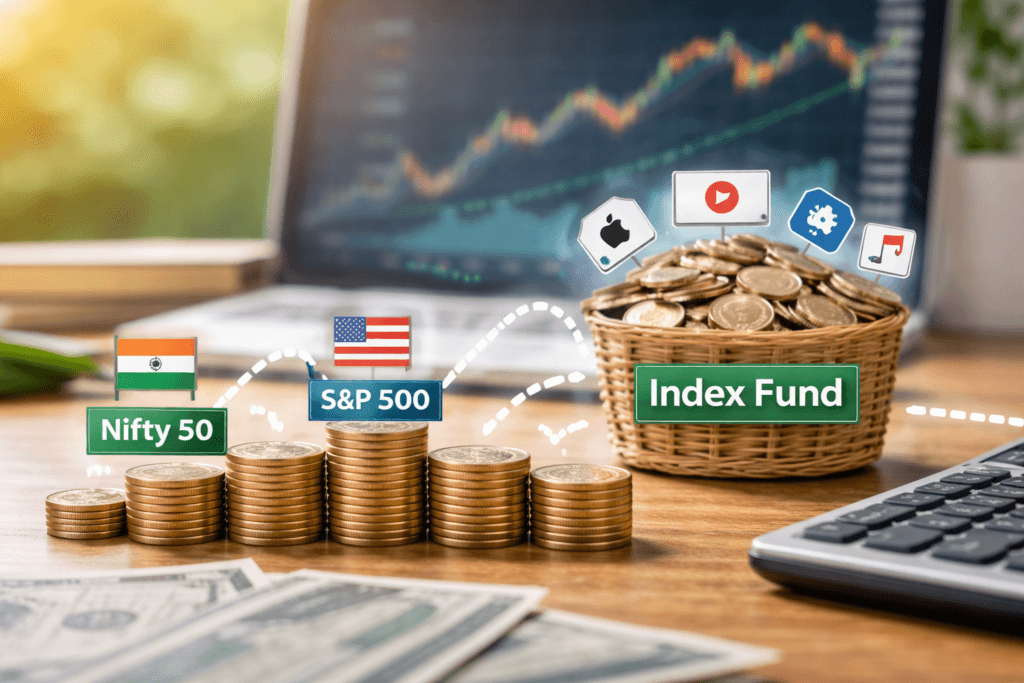
Index funds follow a passive investment strategy. This means the fund does not try to beat the market. Instead, it tries to match the performance of the index.
For example, if the Nifty 50 increases by 10%, your index fund will also grow close to that percentage. The same applies to global indices like the S&P 500.
Because there is no active management, costs are lower. Over time, lower costs help you earn better returns.
Why Index Funds Are Popular in 2026
Index funds have become very popular across the world, especially among beginners.
The main reason is simplicity. You do not need to track news or analyze stocks. You simply invest and stay invested.
Another reason is cost. Index funds have low expense ratios compared to actively managed funds.
They also provide diversification. Instead of relying on one company, your money is spread across many companies.
Most importantly, they help remove emotional decisions. You are not buying and selling based on fear or excitement.
Index Funds vs Active Mutual Funds
| Feature | Index Funds | Active Funds |
|---|---|---|
| Strategy | Passive | Active |
| Fees | Low | High |
| Risk | Moderate | Higher |
| Goal | Match market | Beat market |
| Effort | Low | High |
For beginners, index funds are usually a better choice because they are simple and cost-effective.
Types of Index Funds (India + Global)
1. Broad Market Index Funds
These funds track the entire market.
- India: Nifty 50
- US: S&P 500
These are ideal for beginners.
2. International Index Funds
These funds allow you to invest globally.
For example, Indian investors can invest in US markets, while US investors can invest in emerging markets like India.
3. Sector-Based Index Funds
These focus on specific sectors like IT, banking, or healthcare.
They can give higher returns but come with higher risk.
4. Market Cap Index Funds
These are based on company size:
- Large-cap (stable)
- Mid-cap (growth)
- Small-cap (high risk)
Benefits of Investing in Index Funds
Index funds are popular for a reason. They keep things simple and still help you grow your money over time. Here are some real benefits you should know:
1. You Don’t Put All Your Money in One Company
When you invest in an index fund, your money is spread across many companies.
So even if one company doesn’t perform well, others can balance it out.
This reduces risk and gives you more stability compared to picking individual stocks.
2. Very Low Costs
Index funds don’t need active management, so the fees are much lower.
That means:
- You pay less charges
- More of your money stays invested
In the long run, this small difference in cost can make a big impact on your total returns.
3. No Need to Track the Market Daily
You don’t have to keep checking charts or news every day.
Index funds simply follow the market, so once you invest, you can relax and focus on your life.
This makes them perfect for beginners and busy people.
4. Good for Long-Term Wealth
Index funds are not for quick profits — they are for steady growth.
Over time, markets usually go up, and index funds grow along with them.
If you stay invested for years, your money can grow significantly.
5. Compounding Works in Your Favor
The earlier you start, the better it gets.
Your returns start earning returns, and this keeps building over time.
Even small monthly investments can turn into a large amount if you stay consistent.
6. Simple and Stress-Free Investing
No need to analyze stocks, no need to guess the market.
Just invest regularly (like SIP), stay patient, and let the market do its job.
It’s one of the easiest ways to invest without stress.
If you are looking to build passive income, you can also read our guide on Best Passive Income Ideas in 2026.
Things to Know Before Investing
Before investing in index funds, you should understand a few key points.
Index funds are best for long-term investing. You should stay invested for at least 5 to 10 years.
Short-term fluctuations are normal. Markets go up and down, but long-term growth is what matters.
Returns are not guaranteed. They depend on market performance.
Step-by-Step Guide to Invest in Index Funds
Step 1: Define Your Goal
Decide why you want to invest. It could be retirement, buying a house, or wealth creation.
Step 2: Complete KYC
You need to verify your identity before investing.
- India: PAN, Aadhaar
- Global: ID proof, bank account
Step 3: Choose a Platform
For India
- Zerodha
- Groww
For Global Investors
- Vanguard
- Fidelity
Step 4: Select the Right Fund
Choose a fund based on:
- Expense ratio
- Performance
- Fund size
Step 5: Start Investing
You can invest through:
- SIP (monthly investment)
- Lump sum (one-time investment)
Index funds follow a passive strategy and aim to match market performance. According to the SEC, this approach helps reduce costs and improve long-term returns.
SIP vs Lump Sum
| Type | Description |
|---|---|
| SIP | Invest regularly |
| Lump Sum | Invest one-time |
SIP is better for beginners because it reduces risk and builds discipline.
Best Index Funds (India + Global)
Global
- Vanguard S&P 500 ETF (VOO)
- SPDR S&P 500 ETF Trust (SPY)
India
- Nifty 50 Index Funds
- Sensex Index Funds
- Nifty Next 50 Funds
How Much Return Can You Expect
Index funds usually provide long-term returns.
- US market: 8% to 12% annually
- India market: 10% to 14% annually
These returns are not fixed but give a general idea.
Risks of Index Funds
Index funds are not risk-free.
Market risk is the biggest factor. If the market falls, your investment falls.
There is also inflation risk.
However, compared to individual stocks, index funds are safer.
Common Mistakes to Avoid
Many beginners try to time the market. This usually leads to losses.
Another mistake is panic selling during market crashes.
Some investors also invest without clear goals, which leads to poor decisions.
Long-Term Strategy for Success
The key to success is consistency.
Invest regularly, stay invested, and avoid emotional decisions.
Compounding works best over time.
Conclusion
Index funds are one of the best ways to start investing in 2026. They are simple, low-cost, and suitable for beginners.
Whether you are investing in India or globally, index funds can help you build long-term wealth.
Start small, stay consistent, and focus on long-term growth.
FAQs
Are index funds good for beginners?
Yes, they are simple and low-cost, making them ideal for beginners.
Can I invest with small money?
Yes, you can start with ₹500 or $10.
Which is better: SIP or lump sum?
SIP is better for beginners.
Are index funds safe?
They are safer than individual stocks but still have market risk.
How long should I invest?
At least 5 to 10 years.
Disclaimer
This article is for informational purposes only and should not be considered financial advice. Investments are subject to market risks. Please consult a financial advisor before investing.

Amit Singh is an experienced IT professional and passionate blogger with 8+ years in the technology industry. Through Resource Locator, he shares practical finance strategies, productivity tips, and useful technology insights to help readers make smarter everyday decisions.