

If you are a salaried employee in India, you might have recently heard about the 50% basic pay rule. Many people are confused about what it actually means and how it will affect their salary.
If your salary feels less at the end of the month, you can also read our guide on how to save money fast on low income to manage expenses better.
Some are worried that their salary will decrease. Others think they will earn more. The truth is somewhere in between.
In this guide, I will explain everything in very simple language so that you can clearly understand how this rule works and what changes you can expect in your salary.
What is 50% Basic Pay Rule?
The 50% basic pay rule comes under the Code on Wages, 2019, which is part of India’s new labour laws.
According to this rule:
Your basic salary must be at least 50% of your total salary (CTC).
Let’s understand this in simple words.
Your salary has many parts:
- Basic salary
- HRA (House Rent Allowance)
- Special allowance
- Bonus
- Other allowances
Earlier, companies used to keep the basic salary low and increase allowances. This helped them reduce contributions like PF.
But now, this is not allowed.
If your allowances become more than 50% of your total salary, then the extra amount will be added back to your basic salary.
This means companies cannot reduce your basic salary too much.
According to the official labour code rules, basic pay must be at least 50% of total salary.
Why Government Introduced This Rule?
There are some strong reasons behind this rule.
1. To Increase Employee Savings
Earlier, because basic salary was low, employees were contributing less to PF.
Now, since basic salary will increase, PF contribution will also increase. This means better savings for the future.
2. To Make Salary Structure Transparent
Many employees did not understand their salary structure.
Companies used to add many allowances which made salary confusing.
This rule makes salary simple and clear.
3. To Improve Retirement Benefits
Benefits like:
- Provident Fund (PF)
- Gratuity
are calculated based on basic salary.
If basic salary is higher, your retirement benefits will also be higher.
4. To Stop Misuse by Companies
Some companies used to show higher CTC but lower real benefits.
Now, this rule ensures fair salary distribution.
Old Salary vs New Salary Structure
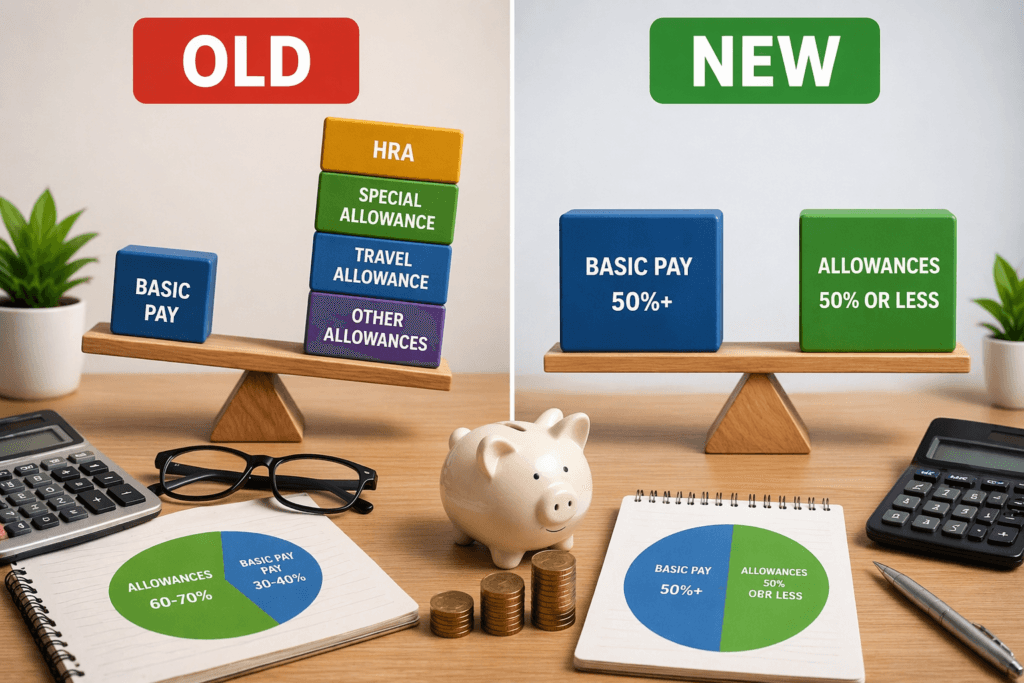
Let’s compare how salary looked before and after this rule.
Old Salary Structure
- Basic Salary: Low (30–40%)
- Allowances: High
- PF Contribution: Low
- In-hand Salary: High
Companies used to give more allowances like:
- Travel allowance
- Special allowance
- Bonus
This reduced PF deduction.
New Salary Structure
- Basic Salary: Minimum 50%
- Allowances: Reduced
- PF Contribution: Increased
- In-hand Salary: Slightly lower
Now:
- Salary is more balanced
- Long-term benefits increase
Impact on In-Hand Salary
This is the most important question people have.
Will your in-hand salary increase or decrease?
Short Answer:
Your in-hand salary may decrease slightly.
Why?
Because:
- PF contribution increases
- Deductions increase
Let’s understand:
Earlier:
- Low PF → More take-home salary
Now:
- High PF → Less take-home salary
So, your salary is not reduced, but more money goes into savings.
If your in-hand salary changes, you can manage it better using the 50/30/20 budget rule to divide your income smartly.
Impact on PF Contribution
This is where the biggest change happens.
PF (Provident Fund) is calculated as:
- 12% of basic salary (employee contribution)
- 12% by employer
If your basic salary increases:
- PF contribution increases
Example:
Earlier:
- Basic salary: ₹15,000
- PF: ₹1,800
Now:
- Basic salary: ₹25,000
- PF: ₹3,000
This means:
- Less money in hand
- More savings for future
Benefits and Disadvantages
Let’s look at both sides.
Benefits
1. Better Savings
More PF means better savings.
2. Higher Gratuity
Gratuity is calculated on basic salary. So it increases.
3. Financial Security
You get more money during retirement.
4. Transparent Salary
No confusing allowances.
Disadvantages
1. Lower In-Hand Salary
You may feel salary is reduced.
2. Higher Deductions
PF and other deductions increase.
3. Less Flexibility
Companies cannot design flexible salary structures.
Example (Real Salary Calculation)
Let’s understand with a simple example.
Total Salary (CTC): ₹50,000
Before Rule
- Basic Salary: ₹15,000
- Allowances: ₹35,000
- PF (12% of 15,000): ₹1,800
In-hand salary: Higher
After Rule
- Basic Salary: ₹25,000
- Allowances: ₹25,000
- PF (12% of 25,000): ₹3,000
In-hand salary: Lower
What Changed?
- PF increased by ₹1,200
- Savings increased
- Take-home reduced slightly
FAQs
1. Will my total salary increase?
No, your total CTC will remain the same.
Only the structure changes.
2. Will the 50% basic pay rule reduce my in-hand salary?
Yes, your in-hand salary may reduce slightly because your PF contribution increases when your basic salary becomes higher.
3. Is this rule already implemented?
Yes, it is effective from November 2025.
4. Does this apply to all employees?
Yes, it applies to most salaried employees.
5. Are bonuses included in wages?
No, performance bonuses are not included in wage calculation.
6. Is overtime included in wages?
Yes, overtime is included in wage calculation.
7. Will this rule benefit me?
Yes, in the long term.
You will get:
- Higher gratuity
- Better savings
- Higher PF
8. How does the 50% basic pay rule affect PF contribution?
Since PF is calculated on basic salary, a higher basic pay means higher PF contribution. This increases your long-term savings.
Final Thoughts
The 50% basic pay rule may look confusing at first, but it is actually a good step.
You may feel that your in-hand salary has reduced, but in reality, your money is just going into savings.
In the long run, this rule will help you build:
- Better financial security
- Strong retirement savings
So instead of worrying about lower take-home salary, focus on the benefits you will get in the future.
For more helpful tips like this, explore our Personal Finance guides where we cover budgeting, saving, investing, and more.
Disclaimer
The information provided in this article is for general informational and educational purposes only. It is based on publicly available sources and official guidelines related to the Code on Wages, 2019.
This content does not constitute legal, financial, or professional advice. Salary structures may vary depending on company policies, employment terms, and individual circumstances.
While we aim to keep the information accurate and up to date, we do not guarantee the completeness or accuracy of the content. Readers are advised to consult with a qualified professional or refer to official government sources before making any financial or employment-related decisions.
We are not responsible for any loss or damage resulting from the use of this information.

Amit Singh is an experienced IT professional and passionate blogger with 8+ years in the technology industry. Through Resource Locator, he shares practical finance strategies, productivity tips, and useful technology insights to help readers make smarter everyday decisions.